


Your selling price can look profitable at first glance and still leave you with far less than expected once the full cost of an order is counted.
Production is only one part of the equation. Shipping, marketplace fees, payment charges, discounts, advertising costs, taxes, and occasional replacements can reduce your print-on-demand profit margin considerably.
If you are learning how to price print-on-demand products, the goal is to set a price that covers these expenses, supports a healthy margin, and stays competitive within your niche.
This guide will show you how to price print on demand products based on the actual cost of selling each product.

Markup and profit margin describe the same sale from two different angles. Markup measures profit against the product cost, while margin measures profit against the retail price. Current ecommerce pricing guidance uses these same definitions, and mixing them up can lead you to set a lower price than you intended.
For print-on-demand pricing, the distinction matters because a 50% markup does not produce a 50% margin.
Markup = (Selling price − cost) ÷ cost × 100
Suppose your product costs $15 and you apply a 50% print-on-demand markup:
$15 × 1.50 = $22.50
Your profit before other expenses is $7.50.
Margin = (Selling price − cost) ÷ selling price × 100
Using the same example:
$7.50 ÷ $22.50 × 100 = 33.3%
So, although you added a 50% markup, your resulting margin is only 33.3%.
If your target is an actual 50% margin, you need to calculate the selling price from the desired margin instead:
Selling price = cost ÷ (1 − desired margin)
$15 ÷ (1 − 0.50) = $30
That gives you a $30 selling price and a 50% margin before other selling expenses are deducted. This method is also consistent with current pricing guidance for calculating a price from a target margin.
| Pricing Target | Calculation | Selling Price | Resulting Margin |
| 30% markup | $15 × 1.30 | $19.50 | 23.1% |
| 50% markup | $15 × 1.50 | $22.50 | 33.3% |
| 50% margin | $15 ÷ 0.50 | $30.00 | 50% |
For a POD pricing strategy, decide first whether your target percentage refers to markup or margin. That single distinction can prevent a pricing error before you start accounting for shipping, platform fees, advertising, and other costs.
The price listed in a supplier catalog does not always represent what you will pay for every version of a product. Production charges can change with the selected variant, size, material, printing method, and number of design areas.
Calculate these expenses for each SKU you plan to sell rather than applying the same cost assumption across your whole catalog.
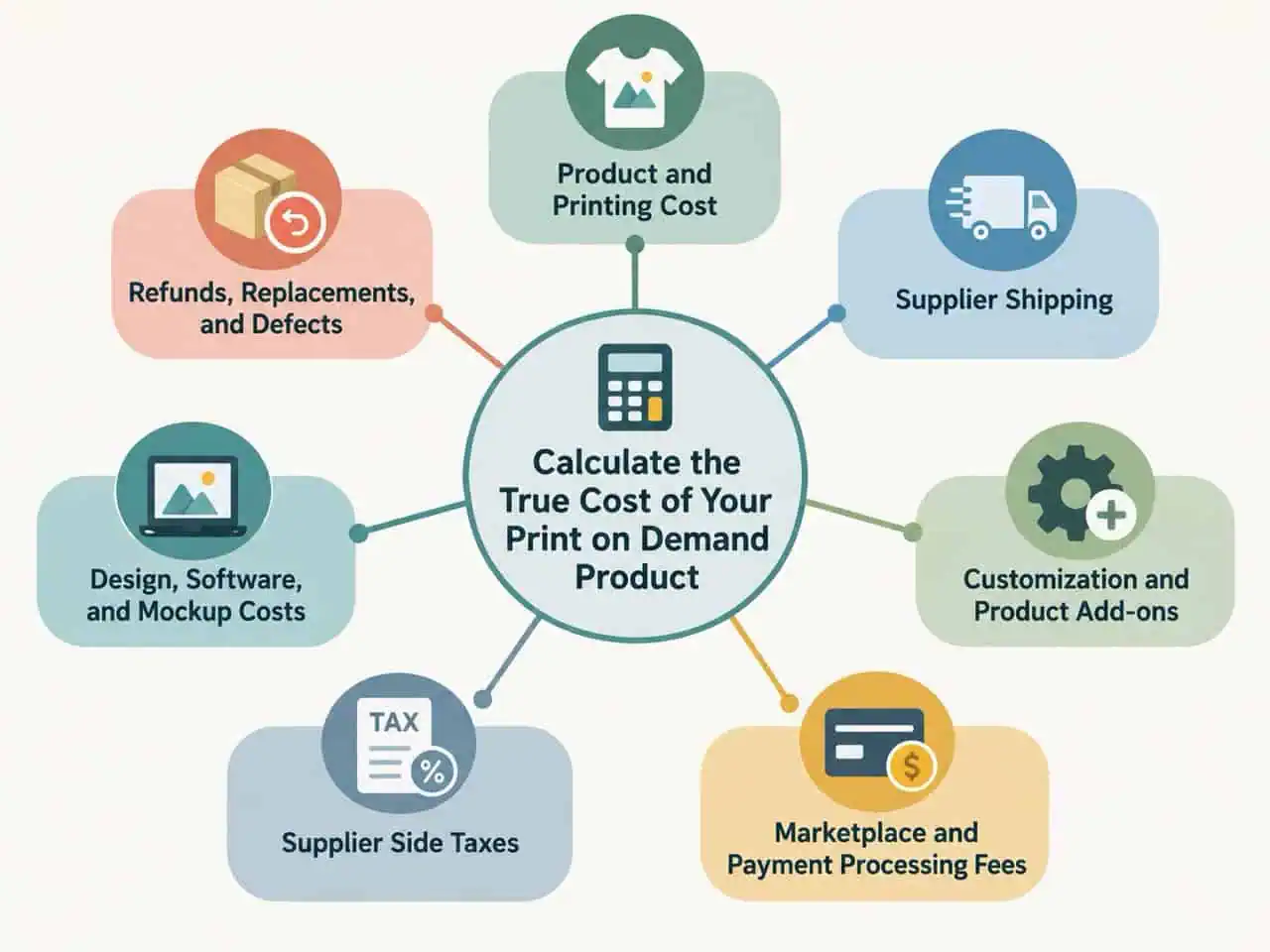
Record the production charge for the exact product variant you are selling. A premium blank may cost more than a basic one, while certain colors and larger garment sizes can also carry higher production prices.
Printing choices matter too. DTG, embroidery, and all-over printing can follow different pricing structures. A basic product price may include one design area, while artwork added to the back, sleeve, neck, or another location can increase the charge.
Use the final supplier cost for your chosen size, material, printing method, and placements instead of calculating profit from an advertised starting price.
Supplier shipping can change according to destination, product type, delivery method, and the number of items in an order. Some fulfillment providers charge one rate for the first item and a lower rate for eligible additional items, while mixed products may be charged separately. International and express options can also cost more.
Use the shipping charge attached to the actual order scenario when estimating profit, including any amount you absorb through free shipping.
Customization can change the economics of individual variants. A personalized shirt with sleeve artwork, an embroidered product with extra stitching, or a framed print may cost more to fulfill than its standard version. Branding choices can add another layer, since custom packaging and inserts may involve fulfillment or storage fees.
When buyers can choose upgrades such as labels, personalization, framing, or extra design areas, consider pricing those options separately. Variant-level pricing helps each configuration carry its own cost instead of forcing every customer into one flat retail price.
Selling fees usually fall into two groups, and they affect pricing differently.
Fixed fees can include:
Percentage-based fees can include:
Current marketplace documentation shows that sellers can face both fixed charges and percentage-based fees on the same sale. Some payment processing fees also combine a percentage with a fixed amount.
Do not convert every percentage fee into one fixed dollar estimate before setting your price. If the selling price rises, the dollar value of those percentage charges rises too. Currency conversion and marketplace advertising fees can follow the same pattern when they apply.
Taxes can enter a POD order at different stages, so keep these three concepts separate:
Supplier-side tax can reduce your expected profit margin if it is missing from your cost estimate.
Your fulfillment invoice does not show every expense required to run a POD store. Design software, ecommerce apps, mockup tools, design assets, freelancers, research platforms, and store subscriptions still affect overall profitability.
You can account for these costs in either of two ways:
Choose one method and apply it consistently. Adding an entire monthly subscription to the cost of one product will distort its profitability.
Refunds and replacements will not affect every sale, but they still belong in your profitability model. Once you have enough order history, calculate an average allowance from your own data.
For example: $300 in refund and replacement losses ÷ 1,000 orders = $0.30 expected cost per order
Quality also affects the real cost of fulfillment. Providers may cover certain manufacturing defects, misprints, or damaged items, yet sellers can still face losses from issues outside those policies, customer service decisions, or repeat problems.
A lower production price is less valuable if poor quality leads to frequent replacements, refunds, or customer complaints.
Your break-even price is the lowest selling price that covers the costs included in your calculation. At that point, the order generates neither profit nor loss.
When there are no percentage-based selling fees:
Break-even price = Total per-order costs
Percentage fees require an extra step because their dollar value changes with the retail price. Current ecommerce pricing guidance uses the same principle when accounting for transaction and payment processing percentages.
Break even price = Fixed costs ÷ (1 − total variable fee rate)
Consider this order:
Your fixed order costs total:
$14 + $5 + $0.45 = $19.45
Now account for the 9.5% fee:
$19.45 ÷ (1 − 0.095) = $21.49
So, $21.49 is the approximate break-even selling price under these assumptions.
Charging $19.45 would still leave the order below break-even because the 9.5% fee would be deducted from that transaction. This is why percentage-based charges must be built into the calculation rather than added afterward as a fixed amount.
Once you know your break-even point, you can calculate a selling price that includes your desired contribution margin.
Target selling price = Fixed costs ÷ (1 − variable fee rate − target contribution margin)
Here, target contribution margin is the percentage of sales revenue left after the costs included in the formula.
There is no single ideal percentage for every store. Your target should reflect factors such as:
Market pricing and customer willingness to pay also matter when setting the final retail price.
A lower margin percentage can still generate more profit dollars on a higher-priced item. For example, a 25% contribution margin on a $70 hoodie equals $17.50.
If you sell POD products on Etsy, avoid using one combined fee estimate. Several charges are calculated differently, which can change your actual cost per order.
Current Etsy fees include:
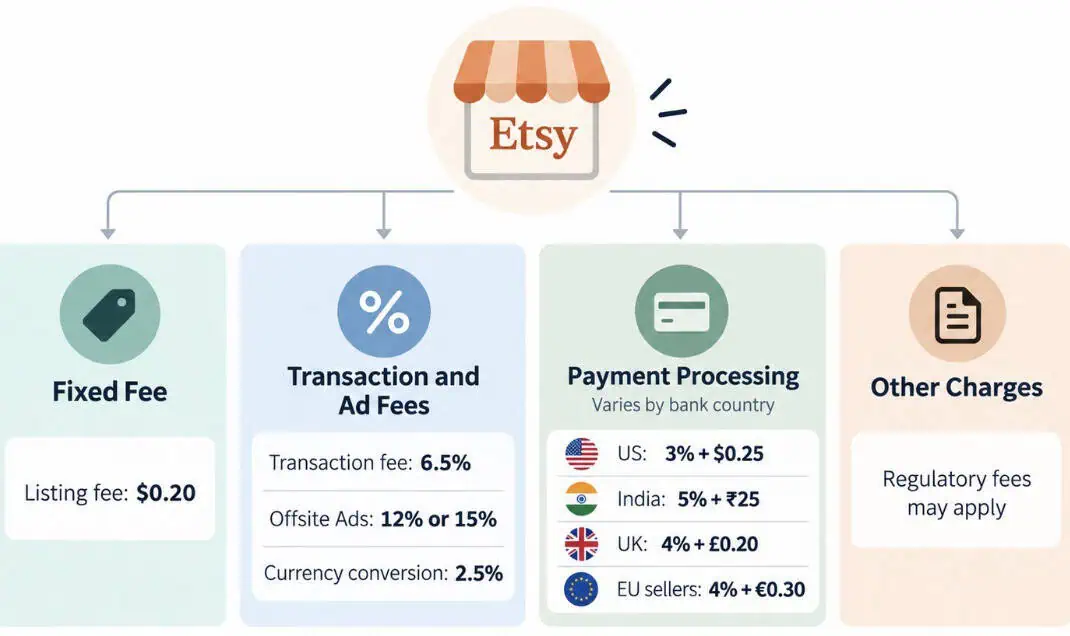
Etsy confirms that its 6.5% transaction fee applies to the item price plus shipping and gift wrapping. Charging more for shipping instead of increasing the item price therefore does not remove that fee.
Payment processing also applies separately and varies by country, so sellers should use the rate linked to their own bank location.
You can structure the same $30 customer total in two ways:
| Offer | Product Price | Shipping | Customer Pays |
| Model A | $25 | $5 | $30 |
| Model B | $30 | Free | $30 |
On a Shopify store, free shipping can be built into your shipping strategy or offered through a discount. Shopify also notes that merchants still need to account for the underlying delivery cost in their pricing.
The better option depends on your fee structure, taxes, multi-item orders, discount rules, buyer expectations, and conversion data. Product discounts and shipping discounts can also be treated separately, which may change the economics of each model.
Test both approaches against actual margin and conversion performance rather than assuming free shipping will always produce the better result.
If you frequently offer 10%, 20%, or 25% promotions, plan the discount before setting the list price. Discounts reduce revenue while many underlying costs remain unchanged, so an unplanned sale can quickly cut into margin.
Required list price = Desired sale price ÷ (1 − discount rate)
If your profitable sale price is $31.32 and you regularly offer 20% off:
$31.32 ÷ 0.80 = $39.15
Listing at $31.32 first would reduce the promotional price to $25.06, which no longer preserves the original target margin.
Track three price points:
| Number | Meaning |
| Break-even price | Lowest price before the order loses money |
| Target price | Price built around your intended contribution margin |
| Promotional floor | Lowest acceptable price during a promotion |
Set the promotional floor before launching the sale, then check whether the discount still supports the margin you are willing to accept.
Keep advertising separate from basic product costs so you can compare profitability before and after customer acquisition.
Contribution profit before advertising = Revenue − fulfillment costs − selling fees − other variable operating costs
For a $30 sale that leaves $12 before advertising:
Contribution margin = $12 ÷ $30 = 40%
That gives you an approximate break-even CAC of $12.
You can also calculate:
Break even ROAS = 1 ÷ contribution margin
1 ÷ 0.40 = 2.5x
Under these assumptions, consistently acquiring customers below a 2.5x ROAS would produce a loss. Current ecommerce guidance uses the same break-even ROAS relationship between variable margin and advertising efficiency.
This calculation is useful when evaluating Meta Ads, TikTok Ads, Pinterest Ads, Google Shopping, or paid creator campaigns.
A single product can carry very different costs once customers start choosing sizes, materials, finishes, or personalization. Larger apparel sizes, extra print areas, embroidery, and fulfillment location can all change production cost.
Common examples include:
Framed wall art can also have noticeably different shipping rates from unframed prints, especially as dimensions increase.
You have three practical pricing choices:
Before choosing a flat price, calculate the margin on the most expensive variant customers are likely to buy regularly.
Additional units can sometimes cost less to ship than the first item when they travel in the same order. Fulfillment providers commonly use a first item rate plus a reduced additional item rate for eligible products.
For example:
The second mug adds less shipping cost than sending another separate order. That can create more room for offers such as:
Check the actual additional item rate before setting bundle prices, since some products or separate fulfillment categories may still incur full shipping charges.
Different POD products face different buying behavior, cost structures, and levels of price sensitivity. Instead of applying one markup across your catalog, compare each category against products with similar quality, customization, and positioning.
Basic T-shirts often face heavy comparison shopping, so competitor pricing is only useful when you compare like with like. Look at the same blank quality, printing method, niche, design complexity, shipping setup, and level of personalization.
Premium blanks, original artwork, embroidery, and personalized designs can support a different price point because they change both production cost and perceived value.
If larger garment sizes cost more to produce, calculate profitability for those sizes separately before using one retail price across the entire range.
With hoodies and sweatshirts, profit dollars matter as much as the percentage margin because the base cost is usually higher. Compare like products by fabric weight, garment quality, fit, embroidery, and personalization rather than benchmarking every hoodie against the cheapest option. Official product listings also show that style, size, printing method, and fulfillment location can change production cost.
Check shipping separately as heavier garments can carry higher delivery costs.
Low-priced accessories have less room to absorb fixed payment charges and shipping. A small fee that looks minor on a hoodie can represent a much larger share of revenue on a mug or phone accessory.
If one unit leaves little profit, test bundles, multi-buy offers, or complementary products instead of competing solely on the lowest marketplace price.
Price wall art by format and dimensions rather than applying one margin to every option. Production and shipping can rise considerably between smaller prints, large formats, and framed versions.
Track framed and unframed products separately, then compare both margin percentage and profit dollars. A larger print can still be commercially stronger even with a lower percentage margin if it generates more contribution per order.
Personalized products compete more closely with customized gifts than generic merchandise. That gives you more pricing flexibility when the buyer receives genuine added value from names, dates, photos, or other custom elements.
Include any personalization cost and the greater replacement exposure that comes with incorrect customer details.
Your calculations tell you what you need to charge. Market research tells you whether buyers are likely to accept that price.
Compare products that are genuinely similar in:
Avoid matching the lowest visible Etsy price automatically. A listing may be discounted temporarily, display its cheapest variant, charge shipping separately, or use different materials and fulfillment quality. Etsy also allows sellers to vary prices by product option, so the headline price may not represent every version of the item.
Judge the complete customer offer instead. Competitive pricing works best when you compare products with similar specifications, positioning, shipping, and overall value rather than price alone.
You may reach a point where the lowest price that keeps the product financially viable is still higher than what buyers are willing to pay. Pricing guidance recommends considering costs, market expectations, and customer value together when this happens.
Before reducing your profit to a negligible amount, look for changes that could improve the economics:
If none of these changes produces a workable price, the SKU may not be worth launching. Pricing research can therefore help you eliminate weak product ideas before spending more time on designs, listings, mockups, and promotion.
Strong pricing starts with understanding the economics of each SKU. Before publishing a product, know its break even price, normal selling price, and promotional floor rather than applying one markup across the entire catalog.
As your catalog grows, mockup creation can become another time intensive part of launching products. More designs and variants often mean more visuals to prepare before those listings are ready.
Bulk Mockup helps simplify that workload by creating mockups in bulk and automating repetitive mockup creation tasks. It can handle large batches of designs, resize and align artwork automatically, work with more complex mockup setups, and keep exported visuals organized. Its current product pages position the tool around faster, high volume mockup creation and unlimited output.
If expanding your POD catalog also means spending more time producing product visuals, explore Bulk Mockup to create mockups faster and manage larger design volumes with less repetitive work.
There is no single print on demand profit margin that works for every seller. Product costs, selling channel, advertising spend, competition, order volume, and profit dollars per sale all influence what is sustainable for your store.
A fixed print on demand markup can be a useful starting point, but it does not show what remains after shipping, selling fees, or acquisition costs. Calculate the contribution margin after those expenses before deciding whether the price works.
You can charge shipping separately or incorporate it into the product price and advertise free shipping. Compare the final amount customers pay, your remaining margin, and conversion performance to determine which structure works better.
Discounts reduce the selling price while many costs remain unchanged. Work backward from your desired sale price using Required list price = desired sale price ÷ (1 − discount rate) and establish a promotional floor before scheduling discounts.
First check whether you are comparing equivalent quality, specifications, shipping, and customization. If your viable price remains higher, reconsider fulfillment, the product itself, bundles, audience, or positioning instead of automatically matching the cheaper offer.